

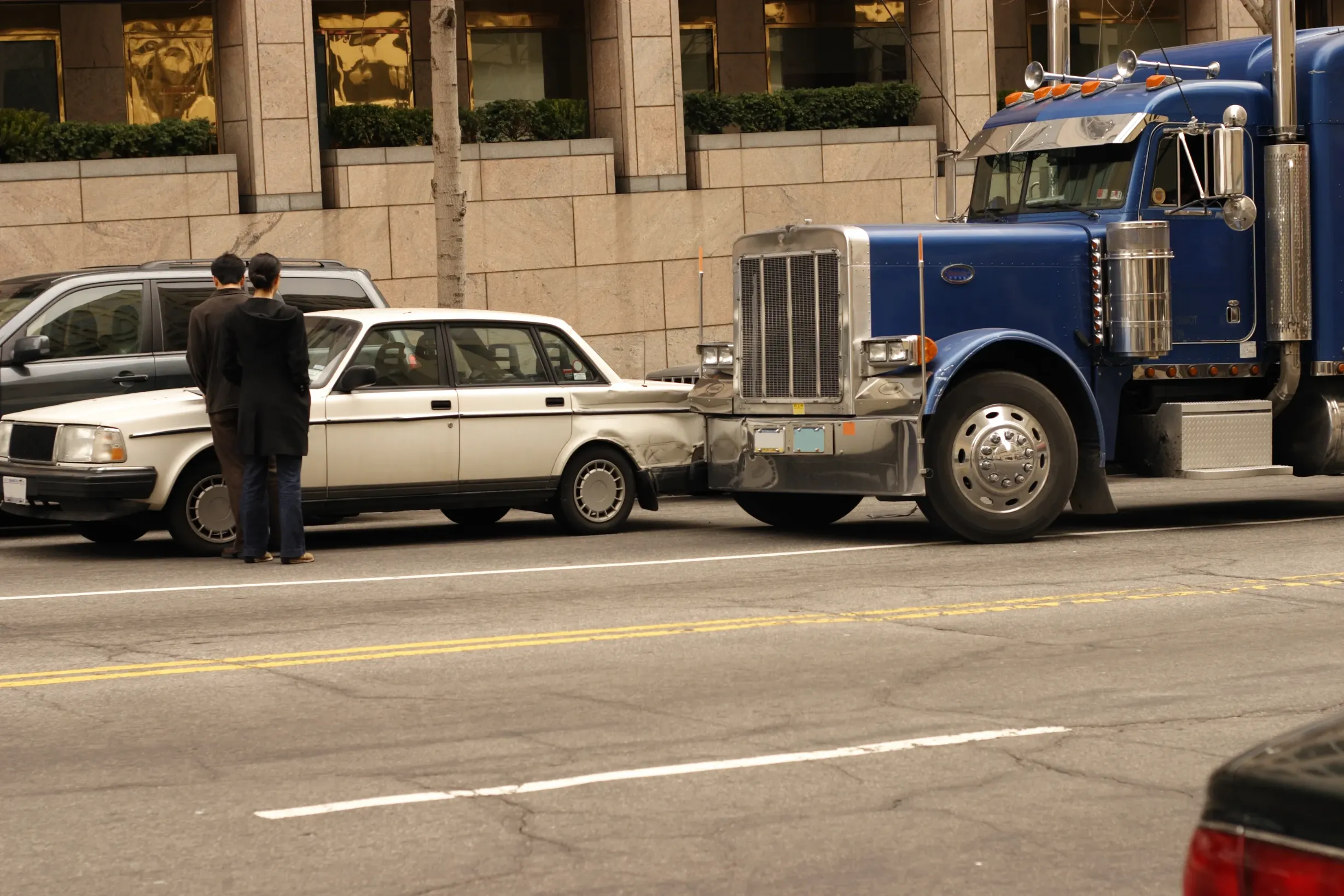
Commercial vehicle accident claims differ from car accident cases in five main ways: stricter safety regulations, multiple liable parties, corporate defendants, far larger insurance policies, and the need to preserve evidence quickly. A standard car crash involves two drivers and two insurers. A commercial wreck in Houston can involve a driver, an employer, a shipper, and a defense team within hours of impact.
Why Do Stricter Regulations Matter After a Commercial Crash?
Commercial drivers and their employers are subject to a set of safety rules that don’t apply to private motorists. The Federal Motor Carrier Safety Administration (FMCSA) writes those standards. Texas applies them to intrastate carriers through Texas Transportation Code § 644.051. Regulated areas that can establish negligence when violated include:
- Hours of service and fatigue limits
- Drug and alcohol testing programs
- Vehicle inspection and maintenance schedules
- Cargo loading and securement standards
- Driver qualification and licensing files
Most car accident cases depend on traffic law and driver behavior. Commercial cases add this entire regulatory record, and a skipped inspection or falsified logbook can weigh as heavily as the collision itself.
Carriers also build a public safety history over time. FMCSA audits, roadside inspection results, and prior citations all become discoverable, and a pattern of past problems makes the current claim much harder for the company to deflect.
A driver in a standard car accident has no comparable paper trail and faces significantly fewer regulations. While those drivers can violate traffic laws that lead to liability, the duty they owe on the road is far less rigorous than what commercial carriers must meet.
Who Answers for the Crash Besides the Driver?
In a typical car accident, the at-fault driver and their insurer are usually the only parties on the other side. Commercial cases are different. Responsibility in a commercial wreck rarely stops with the person behind the wheel.
Depending on how the operation is structured, several businesses may share fault for one collision:
- The motor carrier or employer
- The freight broker or shipper
- A third-party maintenance contractor
- The trailer or cargo owner
- A parts or vehicle manufacturer
Each of those parties typically has its own insurance coverage and defense counsel. Identifying every available policy early is important because the value of serious commercial vehicle claims often exceeds any single policy limit.
Determining who is liable means examining the actual contracts governing the operation, not relying on how any party describes the arrangement after the fact. Lease agreements, brokerage documents, and employment classifications help establish who had legal control of the vehicle at the time of the crash, and the answer is often not what the parties expect. Obtaining these records usually requires formal discovery rather than informal requests.
How Does Corporate Liability Change the Case?
A company can be liable for its driver’s negligence and for its own. Negligent hiring, thin training programs, unrealistic delivery schedules, and ignored safety audits all support direct claims against the business itself, separate from anything the driver did on the road.
No comparable corporate negligence claim exists in most car accident cases, where the other driver is a private individual with no employer, training program, or safety department to hold accountable.
Texas now splits many of these determinations into two. Under Texas Civil Practice and Remedies Code § 72.052, courts hold a first phase on the crash and a second on the company’s conduct, a change that reshaped how commercial claims are built and presented.
For an injured person, this two-phase structure cuts both ways. The first phase focuses on fault and damages, while the second opens the door to additional damages when the evidence shows the company knew of the risk.
What Makes the Financial Stakes Higher?
Commercial insurance policies often far exceed the coverage available in a standard auto policy, sometimes by millions of dollars. Texas requires drivers to carry as little as $30,000 in bodily injury liability coverage per person, while federal rules require for-hire interstate carriers transporting nonhazardous freight to carry $750,000 or more in liability coverage. Because the stakes are higher, insurers often deploy rapid-response teams to crash scenes and begin shaping their defense before the investigation is complete.
The severity of injuries also increases the financial exposure. Larger vehicles generate greater force in a collision, leading to longer treatment timelines and higher lifetime care costs, which, in turn, give insurers a stronger incentive to dispute fault and limit payouts.
When a commercial policy carries millions in coverage, the insurer’s response reflects that. In commercial claims, adjusters often involve litigation specialists early, and settlement negotiations shift once a potential verdict could influence a carrier’s insurance costs across an entire fleet.
Why Is Evidence Collection More Complex?
Most of the proof in a commercial case lives in the trucking company’s hands. After a car accident, the key evidence is usually a police report, photos, and witness statements that both sides can access equally. That changes in a truck crash, where much of the critical proof lives inside systems a private driver never touches, including:
- Electronic logging device (ELD) records
- Onboard camera and telematics data
- Dispatch and delivery schedule records
- Post-crash drug and alcohol test results
- Maintenance and repair histories
Federal retention rules let carriers purge certain records on short cycles, sometimes within months. A preservation letter sent quickly forces the company to keep everything listed above intact while the claim develops.
Some of the most valuable data also needs expert hands. Engine control modules record speed and braking in the final seconds before impact, and an improper download can corrupt that information, which is why reconstruction specialists handle the device itself.
Talk Directly to a Sharma Injury Law Attorney After Your Commercial Crash
Do not wait to get help with your commercial vehicle accident claim. At Sharma Injury Law, we put family at the center of every case. Bash Sharma built this practice alongside his three daughters, and that means you talk directly with the attorneys handling yours, with immediate involvement and no pressure to settle early. Call (281) 893-8644 or contact us online while the records that prove your claim still exist.
Houston Office Location
14411 Cornerstone Village Dr,
Houston, TX 77014, United States
Tel: 281-893-8644